1. Introduction (Computational Systems Framing)
Modern AI-assisted software development has transformed programming into a distributed computational workflow involving language models, autonomous agents, package managers, cloud inference services, authentication systems, and software supply chains. Unlike traditional software execution, these systems continuously consume computational resources in the form of inference tokens, API requests, execution contexts, and runtime permissions.
From a systems engineering perspective, the primary research challenge is no longer simply protecting authentication credentials, but understanding how computational resources propagate throughout an AI ecosystem. Every prompt, dependency, tool invocation, and autonomous agent contributes to a larger execution graph whose behavior must remain observable, explainable, and secure.
This research is inspired by a real-world dilemma: developers running simple prompts only to find 50% of their daily token quotas vanished in seconds, without any visibility into where they went. It points to a deeper systemic flaw where background processes (like NPM package checks, redundant dependency downloads, or backdoor sub-requests) consume resources under the developer’s identity, subsidizing tier-free exploits and systemic leaks.
The fundamental research question becomes:
How can AI infrastructures provide complete computational provenance for token consumption, execution events, and software dependencies while maintaining scalability, security, and operational transparency?
2. The Catalyst: A Real-World Token Leak Scenario
This systems architecture was motivated by a critical real-world anomaly observed in distributed coding pipelines:
- The Outage Exploit: During an extended backend service outage (similar to past OpenAI/Codex outages), a system glitch allowed free or tier-restricted users to bypass rate-limiting controls and access maximum-tier LLM models for 2–3 days.
- Paid-Tier Subsidization: Because the underlying cloud gateway lacked granular resource accounting, the massive token costs incurred by this exploit were absorbed collectively. Paid premium subscribers saw their daily token allocations drain at unprecedented speeds.
- Hidden Background Overhead: Developers running simple, single-line prompts had up to 50% of their daily quota consumed instantly. Investigation revealed the culprits: background package checkers (like automated NPM queries), dependency resolvers pulling redundant libraries that were already cached/pre-installed, and unmonitored toolchain dependencies calling sub-agents.
- The Need for Traceability: In a multi-agent, connected pipeline, tokens behave like cash. Without a zero-trust provenance graph attributing every token consumption event back to its triggering process, paid subscribers end up unknowingly financing anomalous traffic, backdoor processes, or platform bugs.
The flowchart below illustrates this leakage and subsidization vector:
graph TD
    subgraph Developer Workspace
        Dev[User Developer Prompt] -->|Trigger| Agent[AI Coding Agent]
    end

    subgraph Background Toolchain
        Agent -->|Checks| NPM[NPM / Dependency Resolvers]
        Agent -->|Spawns| Scripts[Redundant Pre-install Checks]
        NPM -->|Compromise / Loop| Leak[Backdoor Compute Leak]
    end

    subgraph LLM Gateway & Billing
        Dev -->|Direct Prompt Tokens| Billing[Premium User Quota: -50%]
        Scripts -->|Unattributed Overhead| Billing
        Leak -->|Subsidized Free Traffic| Billing
    end

    classDef danger fill:#ef4444,stroke:#f87171,stroke-width:2px,color:#fff;
    classDef safe fill:#10b981,stroke:#34d399,stroke-width:2px,color:#fff;
    class Leak,Scripts danger;
    class Dev safe;
3. AI Runtime Architecture as a Distributed Computational System
A modern AI development environment can be abstracted as a distributed execution pipeline composed of multiple interacting subsystems.
Core components include:
- Developer interface
- IDE and autonomous coding agents
- Package management ecosystem
- Authentication and authorization services
- Cloud inference providers
- Runtime execution environment
- Observability infrastructure
- Billing and telemetry systems
Unlike conventional software, these components continuously exchange authentication tokens, execution contexts, prompts, responses, and computational resources.
The system operates as a sequence of interconnected trust boundaries:
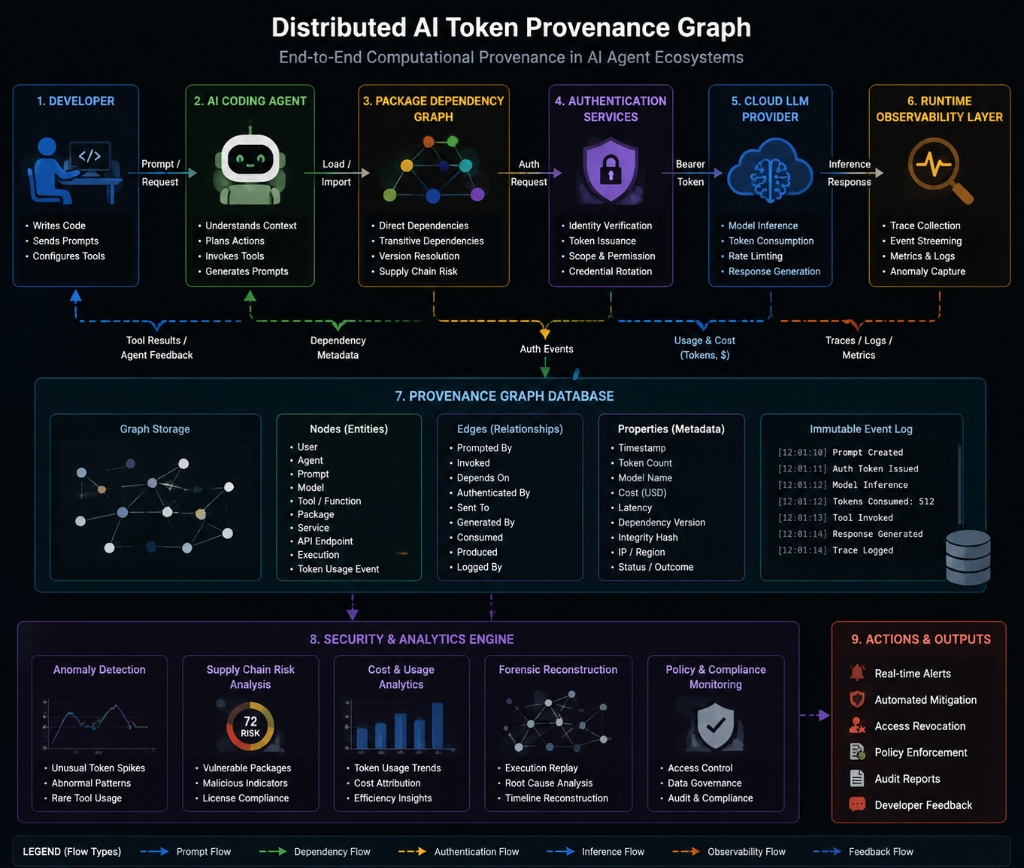
Each transition introduces potential risks involving credential exposure, unauthorized execution, supply chain compromise, or abnormal resource consumption.
4. Computational Interpretation
AI Ecosystem as a Distributed Graph
The AI runtime can be represented as a directed graph
where
- represents computational entities including agents, services, packages, and users.
- represents authenticated interactions, inference requests, tool invocations, and dependency relationships.
Instead of executing as isolated applications, AI systems operate as interconnected computational graphs whose behavior emerges through continuous communication.
Runtime State Machine
Each autonomous agent follows a simplified execution state machine:
Unexpected transitions or repeated execution cycles may indicate abnormal runtime behavior.
Token Consumption as Computational Resource Allocation
Suppose every inference request consumes
tokens.
The total computational cost becomes
where
- is the number of inference requests.
Monitoring only aggregate token usage provides limited visibility into the origin of computational resource consumption. Effective observability requires attribution of every request to its originating process.
Dependency Graph Interpretation
Modern software rarely executes independently.
The dependency ecosystem can be represented as
where
- denotes software packages.
- denotes dependency relationships.
A single imported package may recursively introduce hundreds of transitive dependencies, significantly expanding the effective trust boundary of the application.
Event Provenance Graph
Every runtime event can be modeled as
where
- represents the authenticated identity.
- denotes the user or agent.
- is the execution timestamp.
- identifies the language model.
- denotes computational cost.
- contains runtime metadata.
Instead of isolated log entries, execution events collectively form a provenance graph describing the computational history of the system.
5. Mathematical Modeling
Token Accounting
Let
- denote prompt tokens.
- denote generated response tokens.
The computational cost of a single request becomes
The total system-wide token consumption is
Provenance Mapping
Define a provenance function
where
- denotes execution events.
- denotes origin metadata.
Each execution event should map uniquely to the process, dependency, or agent responsible for generating it.
Dependency Reachability
Given
if
then package can indirectly influence the execution behavior of package through transitive dependency propagation.
Graph traversal algorithms such as Breadth-First Search (BFS) and Depth-First Search (DFS) can efficiently identify affected execution paths.
Runtime Trust Function
A simplified runtime confidence score may be defined as
where
- represents software integrity.
- denotes provenance completeness.
- measures observability quality.
- quantifies anomalous behavior.
- are weighting coefficients.
Higher values correspond to greater confidence in runtime integrity.
6. Engineering Applications
AI Agent Security
Token provenance enables secure attribution of inference requests, allowing organizations to determine precisely which autonomous agent, tool, or process generated each model invocation.
Software Supply Chain Security
Dependency provenance improves the detection of malicious packages, unauthorized updates, dependency confusion attacks, typosquatting, and credential exfiltration by establishing verifiable execution histories.
Cloud Computing
Cloud-native inference services benefit from provenance-aware telemetry capable of correlating authentication events, model invocations, token usage, and billing records into a unified execution trace.
Distributed Systems
Distributed tracing techniques can be extended beyond network requests to capture prompt propagation, tool execution, autonomous decision-making, and computational resource allocation across multiple agents.
Cybersecurity
Runtime provenance graphs significantly improve forensic investigations by reconstructing execution histories, identifying abnormal token consumption, and detecting unauthorized computational behavior before large-scale resource abuse occurs.
7. Research Insights (Systems Perspective)
1. Token Provenance as a First-Class Computational Primitive
Inference tokens should be treated as traceable computational resources whose lifecycle is observable from creation through consumption rather than as simple billing metrics.
2. Software Supply Chains Expand Trust Boundaries
Modern dependency ecosystems recursively increase the trusted computing base, making complete provenance increasingly important for maintaining software integrity.
3. Graph-Based Observability Improves Explainability
Execution histories represented as provenance graphs provide significantly richer diagnostic capabilities than isolated log entries, enabling causal reasoning across distributed AI workflows.
4. Zero-Trust AI Infrastructure
Future AI systems should minimize implicit trust by combining fine-grained authorization, scoped credentials, runtime verification, and continuous provenance monitoring throughout the execution pipeline.
5. Provenance Enables Autonomous Security
Combining distributed tracing with graph analytics creates opportunities for automated anomaly detection, forensic reconstruction, runtime policy enforcement, and self-monitoring AI infrastructures.
8. Conclusion
AI-assisted software engineering fundamentally changes how computational resources are generated, consumed, and secured. Rather than treating inference tokens solely as billing units, future AI infrastructures should model them as traceable computational assets whose origin, execution context, and lifecycle are continuously observable.
By integrating distributed tracing, software supply chain analysis, provenance graphs, and runtime telemetry into a unified architecture, AI ecosystems can achieve significantly higher levels of explainability, accountability, and operational resilience. As autonomous agents become increasingly prevalent, computational provenance will emerge as a foundational capability for building secure, scalable, and trustworthy AI systems.