The Physical Observation
While walking up to my room one day, I got to thinking about how we climb stairs. Most people climb or descend stairs in a straight line, going straight down the middle. Physically, this creates a lot of vertical impact on a single line of travel, concentrating forces on the same ligaments and joints with every step.
If you want to reduce peak force on your knees and ligaments, what if you spread the movement sideways?
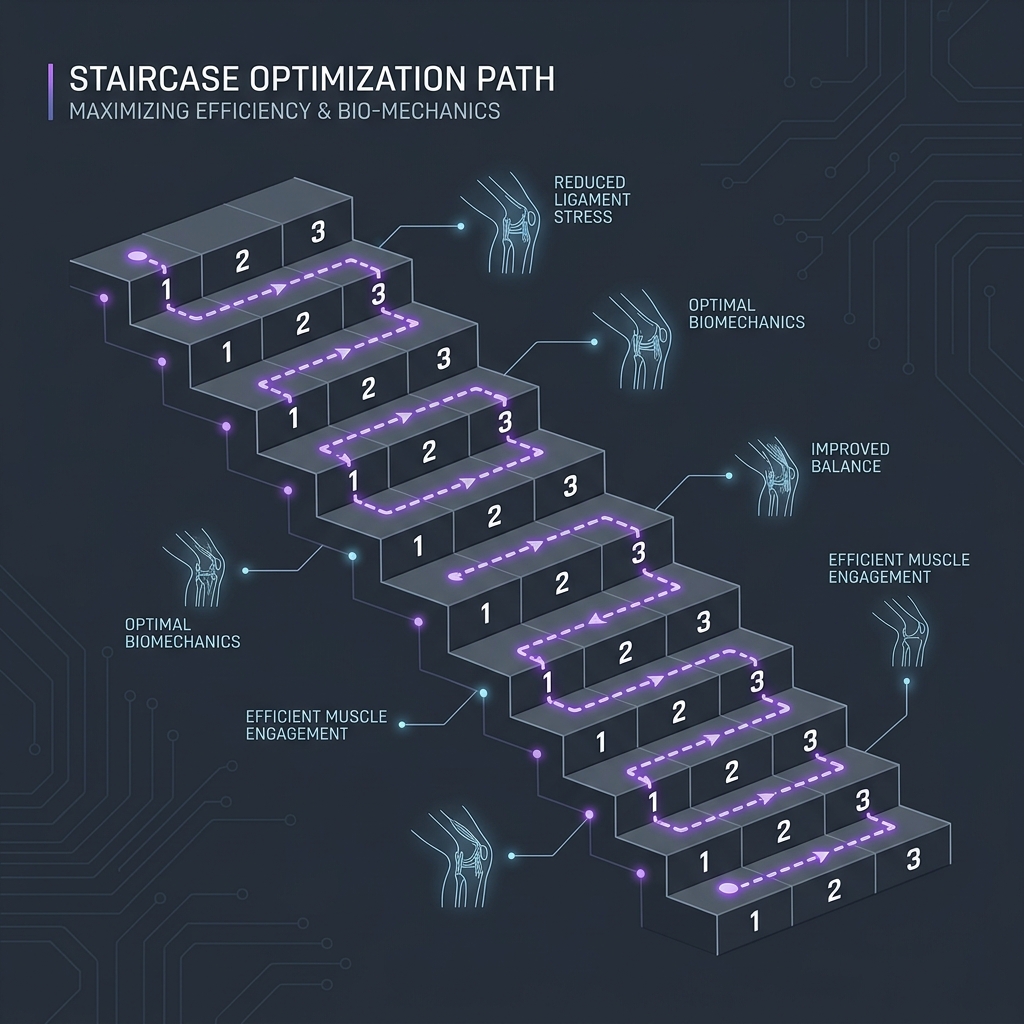
If we model a staircase where each step has 3 columns (left, middle, right: 1, 2, 3), we can walk in a zigzag pattern:
- Step 1: Walk across columns
1 -> 2 -> 3 - Step 2: Walk across columns
3 -> 2 -> 1 - Step 3: Walk across columns
1 -> 2 -> 3 - Step 4: Walk across columns
3 -> 2 -> 1
Additionally, when reaching a mid-rise landing (the turning platform), instead of making a sharp pivot or continuing straight, rotating the body into the turn helps transition momentum smoothly and cuts down on knee torque.
Here is a visual mapping of this optimization path:
The Biomechanical Intuition
From a physics perspective, the total work required to lift your body weight to a height is constant:
However, peak mechanical stress on your joints is not constant. When you walk straight up or down:
- The force vector is aligned directly with your leg extension.
- The deceleration force (when going down) is absorbed entirely by your knees and patellar ligaments over a short time interval.
By zigzaging:
- You increase the total distance traveled, which spreads the deceleration force over a longer path.
- You change the angle of force entry, utilizing lateral hip and calf muscles to absorb some of the shear stress instead of overloading the knees.
- You improve balance by constantly shifting your center of mass.
Modeling it as a LeetCode Problem
What makes this fascinating is that this real-world biomechanical optimization maps directly to classic computer science algorithms. If an interviewer wanted to turn this into a LeetCode question, here is how they would formulate it:
Problem Statement: “Minimizing Staircase Joint Stress”
Imagine a staircase represented as an grid, where is the number of steps. Each cell contains an integer representing the joint stress/cost of stepping on that column of the step.
You start at the top step (row ) and want to reach the bottom step (row ).
From a cell , you can only transition to the next step by moving to columns:
- Diagonally left: (only if )
- Straight down:
- Diagonally right: (only if )
Return the minimum total accumulated stress to descend the stairs.
Algorithmic Solution (Dynamic Programming)
This is a classic variation of the Minimum Falling Path Sum problem (LeetCode 931).
If we use a greedy approach (always choosing the lowest stress column on the next step), we might get stuck in a locally optimal choice that forces us into a high-stress step later. Therefore, we must use Dynamic Programming (DP).
Let be the minimum stress to reach cell from the top. The state transition relation is:
(with boundary conditions handled for columns and ).
Here is how we write it in Python:
def minStaircaseStress(stress: list[list[int]]) -> int:
    n = len(stress)
    # Copy the first row as base cases
    dp = list(stress[0])

    for r in range(1, n):
        next_dp = [0] * 3
        # Column 0 transitions from previous col 0 or 1
        next_dp[0] = stress[r][0] + min(dp[0], dp[1])
        # Column 1 transitions from previous col 0, 1, or 2
        next_dp[1] = stress[r][1] + min(dp[0], dp[1], dp[2])
        # Column 2 transitions from previous col 1 or 2
        next_dp[2] = stress[r][2] + min(dp[1], dp[2])
        dp = next_dp

    return min(dp)
Adding the Landing Turn Constraint
To make it a LeetCode Hard problem, we could add the landing platform constraint:
Every steps, there is a mid-rise landing platform. If you transition through the landing without rotating (i.e. maintaining the same diagonal direction), you incur a turning penalty of stress. Find the optimal route.
This introduces a state-tracking constraint, meaning our DP state would need to track the direction of our last step to calculate the transition penalties correctly.
Conclusion
We don’t always need to sit in front of a IDE to practice algorithmic thinking. Some of the best optimization models come from observing physical constraints in our daily lives—whether it’s navigating stairs to save our knees, or organizing shelves to minimize search latency.
Next time you climb a set of stairs, try the zigzag and feel the dynamic programming in action!